
Stairwells and high ceilings are the hardest part of most houses to paint, and the part most often left out of a quote or priced as if it were an ordinary wall. The paint is the same. Everything around getting it on there is not.
If your home has a double-height entry, a stairwell void, a raked ceiling or a mezzanine, this is what changes.
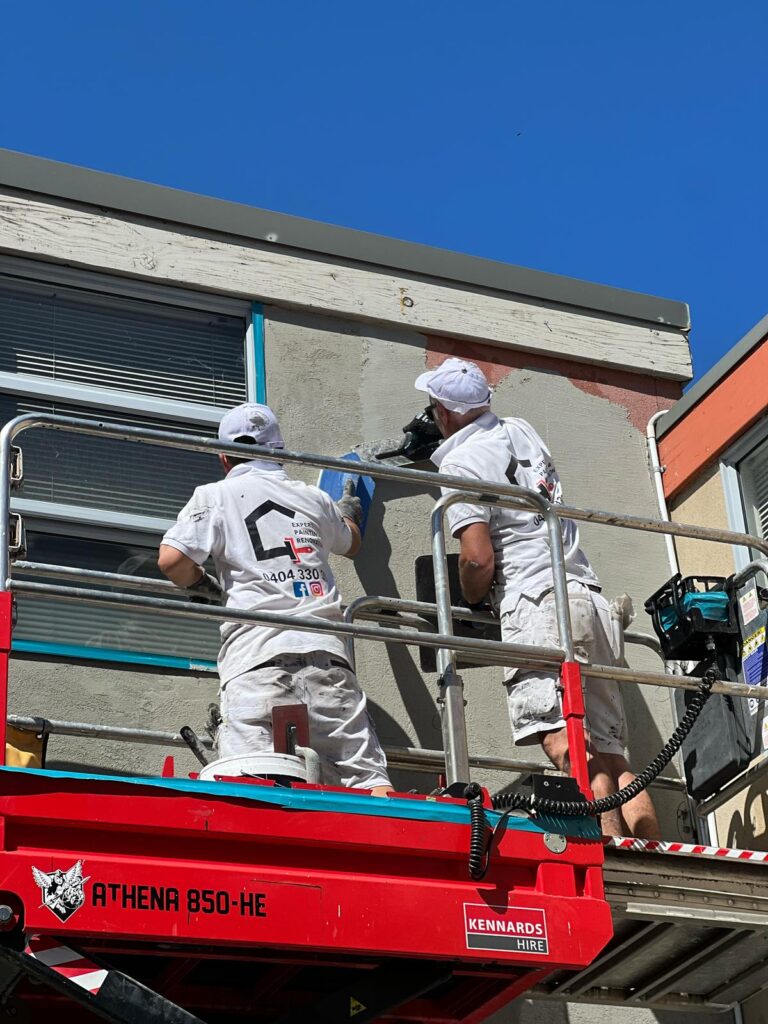
Why height indoors is harder than height outdoors
Outside, you can almost always put scaffold or a platform on level ground. Inside a stairwell you cannot. The floor is a flight of stairs, which means there is no level base under the area you most need to reach.
A ladder on a stair tread is not a safe setup — the feet sit on different levels, the tread edge is a pivot point, and the only thing stopping it sliding is friction on a surface that may be polished timber. Anyone who offers to do your stairwell off a ladder leaning across the stairs is telling you something about how they work.
The legitimate options are a purpose-built stair platform or podium that levels across the treads, a mobile scaffold tower erected in the void where there is floor to stand it on, or staged trestle work with proper stair fittings. All of them take time to set up, adjust and take down, and all of them have to be re-set as the work moves around the void.
Why stairwells and high ceilings cost more
A stairwell void might be 25 square metres of wall. On a flat ground-floor wall that is an hour or two of rolling. In a void it can be most of a day, and the painting itself is a small part of it.
That is the single thing worth understanding before you compare quotes. The labour is in erecting access, protecting the stairs and floors beneath, moving the setup three or four times to reach different faces, and dismantling it. A quote that prices your stairwell at the same rate per square metre as your bedrooms has not accounted for any of that.
It also means some efficiencies are worth taking. If the stairwell needs plaster repairs, those should happen while the access is up, not as a separate visit. Same with light fittings, smoke alarms and anything else at height. Getting access into a void twice costs roughly twice as much as getting it up once.
Floors and stairs take the load
Scaffold feet concentrate weight. On polished boards, parquetry or tiles, that needs proper spreading and protection underneath, not a drop sheet. Carpeted stairs need covering that will not shift under foot while someone is carrying components up them.
Worth asking specifically what goes down and in what order, because this is where damage happens on otherwise good jobs.
The wet edge problem on tall walls
Here is a technical constraint that explains a lot of poor results on high walls.
Paint has to be rolled into a wet edge. Once the previously applied section has started to set, rolling the next section against it leaves a visible join — a lap mark. On a 2.4 metre wall a painter can comfortably work full height and keep the edge wet. On a 6 metre wall nobody can, because you cannot reach top to bottom in one pass.
The ways around it are to work in deliberate full-height sections with enough people to keep moving, to use a paint with a longer open time, and to plan where the joins fall — at a corner or a change of plane rather than in the middle of a feature wall. What does not work is treating it like a normal wall and hoping.
This is also why large high walls are usually painted in a matt or low sheen. The higher the gloss, the more the lap marks and roller texture show.
Raking light will find everything
Double-height spaces almost always have high windows, and high windows throw light across the wall at a shallow angle. That raking light is the most unforgiving lighting condition there is. It exposes roller texture, lap marks, patch flashing, nail pops and any undulation in the plaster.
Two practical consequences. First, surface preparation in a stairwell needs to be better than elsewhere in the house, not the same. Second, sheen choice matters more here than in any other room — if you are unsure, go flatter than you think you need.
The cracks at the top are telling you something
Stairwell walls crack at the top more than other walls, and there is a reason. The void is tall, often spans two structural levels, and the wall is usually a long unbraced span. Normal seasonal movement concentrates there.
Those cracks need to be properly cut out, filled and reinforced rather than skimmed over, and they need to be done while the access is up. A crack that has been filled three times and keeps coming back is a movement crack and needs a different approach — it is worth understanding what the crack pattern means before deciding how to treat it.
Raked and cathedral ceilings
Raked ceilings add a second problem on top of access: there is no consistent working distance. The ceiling gets further away as it rises, so a setup that works at the low end does not reach the high end.
They also tend to have exposed beams, ridge boards or junctions where the ceiling meets the wall at an awkward angle, and every one of those is a cutting-in line someone has to hold straight while standing on a platform. It is slow, careful work and the finish depends almost entirely on who is doing it.
Living in the house while it happens
A stairwell is usually the only route between floors, which makes this the most disruptive part of an interior repaint. Access equipment in the void means restricted or blocked stairs for part of the time.
Ask for this to be sequenced explicitly — which days the stairs are unusable, whether there is a window each evening, and whether the work can be staged so one side stays passable. On most jobs it can be, if it is planned.
Stairwells and high ceilings: what to ask
- What access are you using in the void, and is it priced separately?
- Is the stairwell costed at a different rate to the rest of the house?
- What plaster repairs are being done while the access is up?
- What sheen are you recommending for the high walls, and why?
- How many days will the stairs be restricted?
Get the void quoted properly
We price access and painting separately so you can see what the height is actually costing, and we do the repairs and the light fittings while the scaffold is up rather than coming back. Call 0404 330 332 and we will come and look at the space.
📍 Our Service Areas Across Melbourne, the Mornington Peninsula, Surf Coast & Phillip Island
Melbourne & Bayside
- Expert Painting and Renovation in Richmond
- Expert Painting and Renovation in St Kilda
- Expert Painting and Renovation in South Yarra
- Expert Painting and Renovation in Malvern
- Expert Painting and Renovation in Hawthorn
- Expert Painting and Renovation in Kew
- Expert Painting and Renovation in Balwyn
- Expert Painting and Renovation in Mount Waverley
- Expert Painting and Renovation in Ringwood
- Expert Painting and Renovation in Doncaster
- Expert Painting and Renovation in Hampton
- Expert Painting and Renovation in Frankston
- Expert Painting and Renovation in Mount Eliza
- Expert Painting and Renovation in Mornington
- Expert Painting and Renovation in Mount Martha
- Expert Painting and Renovation in Rosebud
- Expert Painting and Renovation in Sorrento
Phillip Island & Bass Coast
- Expert Painting and Renovation in Flinders
- Expert Painting and Renovation in Somers
- Expert Painting and Renovation in San Remo
- Expert Painting and Renovation in Cape Woolamai
- Expert Painting and Renovation in Cowes
- Expert Painting and Renovation in Coronet Bay
- Expert Painting and Renovation in Tootgarook
- Expert Painting and Renovation in Rye
- Expert Painting and Renovation in Blairgowrie
- Expert Painting and Renovation in Portsea
- Expert Painting and Renovation in Inverloch
- Expert Painting and Renovation in Kilcunda
- Expert Painting and Renovation in Ventnor
- Expert Painting and Renovation in Newhaven
Surf Coast & Bellarine Peninsula
- Expert Painting and Renovation in Geelong
- Expert Painting and Renovation in Torquay
- Expert Painting and Renovation in Ocean Grove
- Expert Painting and Renovation in Barwon Heads
- Expert Painting and Renovation in Anglesea
- Expert Painting and Renovation in Lorne
- Expert Painting and Renovation in Apollo Bay