

Spray, brush or roller is not a quality ranking. They are three tools that suit different conditions, and a painter who only ever uses one of them is working around their equipment rather than around your house.
Here is how the choice between spray, brush or roller actually gets made, and when spraying is a genuine advantage rather than a shortcut.
What each tool is good at
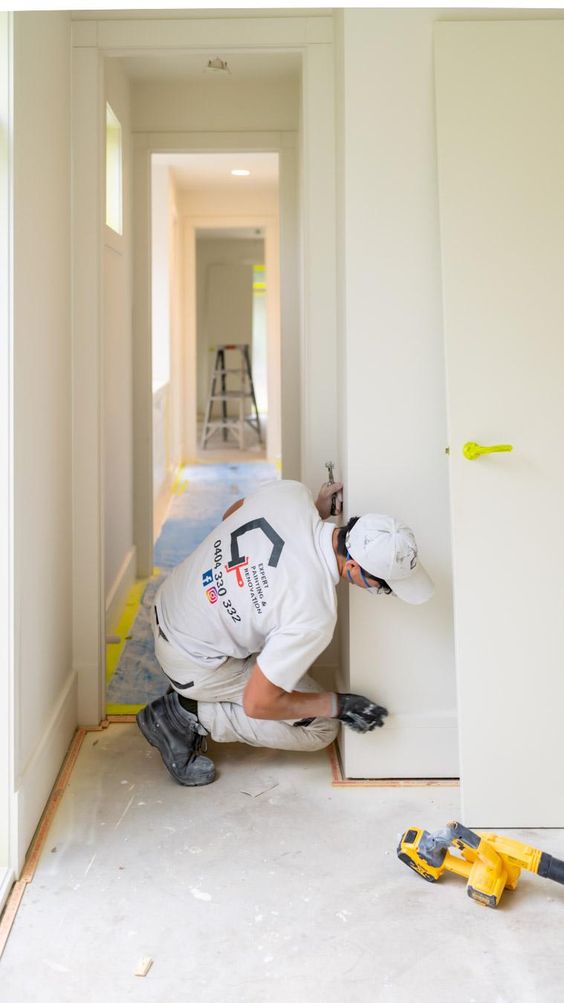
A brush gives the most control and the least speed. It is the only sensible option for cutting in against a ceiling line, for window frames, for the inside edges of door frames, and for anything where the paint has to stop in a precise place. On trim, a well-loaded brush laid off in one direction gives a finish most people cannot distinguish from spray.
A roller is the workhorse for broad flat areas, and it has one quality nobody talks about: it is self-regulating. A roller can only hold so much paint and can only lay off so thin, so it naturally delivers film thickness in the right range. Walls and ceilings are rolled because rolling is reliable, not because it is cheap.
A sprayer is the fastest way to get paint onto a surface and the best way to get a mark-free finish on detailed or repetitive work. It is also the only method that applies no mechanical pressure, which matters on fragile or intricate surfaces.
The economics nobody explains
Spraying is only faster when the masking takes less time than the spraying saves. That sounds obvious, and it is the whole story.
On an empty house with bare floors, spraying walls and ceilings is dramatically quicker. On an occupied home with furniture, floor coverings, light fittings, window treatments and a kitchen, masking can take longer than the painting. At that point a two-person team rolling the job finishes sooner and leaves less risk behind.
This is why the same painter will spray one job and roll the next. If someone quotes spray for an occupied, fully furnished interior, ask how long the masking is costed at.
Where spraying genuinely wins
- Empty houses and new builds, before floors and fittings go in.
- Roofs. Tile and metal roofs are sprayed because the surface area is enormous and the profile is irregular.
- Colorbond, metal cladding and garage doors, where a mark-free finish is the point.
- Fences, lattice, balustrades and anything with a lot of edges and gaps.
- Doors, cabinetry and joinery, ideally sprayed off their hinges and laid flat.
- Textured and heavily profiled surfaces, where a roller cannot reach into the texture.
- Most commercial and industrial work, where areas are large and buildings are usually empty out of hours.
Back-rolling, and why spray alone is sometimes a shortcut
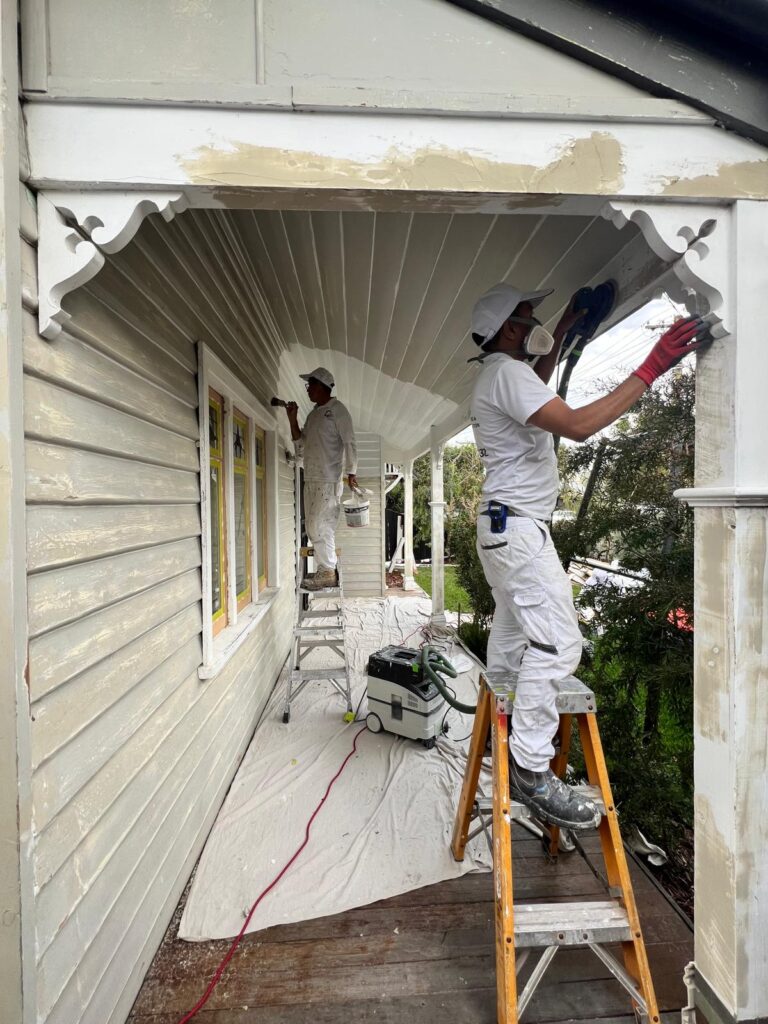
On porous surfaces — render, masonry, bare cement sheet, textured coatings — spraying alone lays paint on top of the surface without working it in. It looks fine on day one and fails early, because the paint never properly wetted the substrate.
The correct method is to spray and then immediately back-roll, pushing the wet paint into the surface before it sets. It is slower than spraying and faster than rolling alone, and it is the standard on rendered exteriors.
If a quote for a rendered or masonry exterior says spray and does not mention back-rolling, that is worth a direct question. It is the difference between a coating that is bonded and one that is merely sitting there.
Film build cuts both ways
A roller struggles to go badly wrong on thickness. A sprayer can do both extremes.
Moving too fast, or holding the gun too far off, lays down a coat far thinner than specified — it covers visually while delivering a fraction of the protection. Moving too slowly, or overlapping too much, floods the surface and causes runs and sags that have to be sanded out once cured.
Spraying well is a skill, and the margin between a superb spray finish and an expensive mess is narrower than most people assume. Ask whether the person holding the gun is the one who will be there on the day.
The Melbourne complications
Overspray is the practical constraint, and inner-suburban Melbourne makes it a serious one. Spraying an exterior in Richmond, Fitzroy or Collingwood means terrace houses with little or no setback, cars parked within a metre of the wall, and neighbours’ windows directly opposite. Atomised paint travels further than people expect, particularly in the wind that comes through in spring.
A painter planning to spray an exterior in a tight street should be telling you what they are masking, which way the wind needs to be blowing, and what the plan is if it is not. If they have not raised it, they have not thought about it.
Apartments and strata properties often have explicit rules about spraying on common property, and some owners corporations require notice to residents. Worth checking before the quote is accepted rather than after.
Coastal and Peninsula properties have their own wrinkle: the sea breeze is reliable and strong, and the only workable spray windows are often early morning.
Spray, brush or roller: what a good answer sounds like
- Walls and ceilings rolled, trim brushed or sprayed, on an occupied house.
- Roof, metal cladding and fences sprayed.
- Render and masonry sprayed and back-rolled.
- Doors and joinery sprayed where they can be taken off and laid flat.
- A masking plan that is specific about what is covered and for how long.
If the method changes by surface, you are talking to someone who has looked at the job. If it is one method for everything, you are talking to someone with one piece of equipment.
Ask us how we would do yours
We pick the method surface by surface and tell you on the quote which is which, including the masking. If you want a straight recommendation for your place, call 0404 330 332.
📍 Our Service Areas Across Melbourne, the Mornington Peninsula, Surf Coast & Phillip Island
Melbourne & Bayside
- Expert Painting and Renovation in Richmond
- Expert Painting and Renovation in St Kilda
- Expert Painting and Renovation in South Yarra
- Expert Painting and Renovation in Malvern
- Expert Painting and Renovation in Hawthorn
- Expert Painting and Renovation in Kew
- Expert Painting and Renovation in Balwyn
- Expert Painting and Renovation in Mount Waverley
- Expert Painting and Renovation in Ringwood
- Expert Painting and Renovation in Doncaster
- Expert Painting and Renovation in Hampton
- Expert Painting and Renovation in Frankston
- Expert Painting and Renovation in Mount Eliza
- Expert Painting and Renovation in Mornington
- Expert Painting and Renovation in Mount Martha
- Expert Painting and Renovation in Rosebud
- Expert Painting and Renovation in Sorrento
Phillip Island & Bass Coast
- Expert Painting and Renovation in Flinders
- Expert Painting and Renovation in Somers
- Expert Painting and Renovation in San Remo
- Expert Painting and Renovation in Cape Woolamai
- Expert Painting and Renovation in Cowes
- Expert Painting and Renovation in Coronet Bay
- Expert Painting and Renovation in Tootgarook
- Expert Painting and Renovation in Rye
- Expert Painting and Renovation in Blairgowrie
- Expert Painting and Renovation in Portsea
- Expert Painting and Renovation in Inverloch
- Expert Painting and Renovation in Kilcunda
- Expert Painting and Renovation in Ventnor
- Expert Painting and Renovation in Newhaven
Surf Coast & Bellarine Peninsula
- Expert Painting and Renovation in Geelong
- Expert Painting and Renovation in Torquay
- Expert Painting and Renovation in Ocean Grove
- Expert Painting and Renovation in Barwon Heads
- Expert Painting and Renovation in Anglesea
- Expert Painting and Renovation in Lorne
- Expert Painting and Renovation in Apollo Bay