
You painted a timber window frame white. Three weeks later there are amber-brown patches coming through it, following the grain, and they are getting darker. You put another coat on and within a month they were back.
That is tannin bleed, and no amount of topcoat will stop it. It needs a different kind of product, and it is one of the most common reasons we get called to look at work that has already been painted once.
What tannin actually is
Tannins are natural compounds in timber — the same family of chemicals that make tea brown and red wine dry. They are concentrated in heartwood, in knots and around resin pockets, and critically they are water-soluble.
That solubility is the whole problem. Water-based paint is mostly water. When you apply it to tannin-rich timber, the water in the paint dissolves tannin at the surface and carries it up into the drying film. As the paint cures, the tannin is left sitting in and on the coating as a brown stain.
It usually appears days to weeks after painting rather than immediately, which is why people assume the paint was faulty. It also tends to get worse after rain or a humid spell, because fresh moisture reactivates it.
The timbers that do it in Melbourne
- Western red cedar. Very high tannin. Cedar window frames and cladding are extremely common in Melbourne homes built through the 1970s and 80s, and they bleed readily.
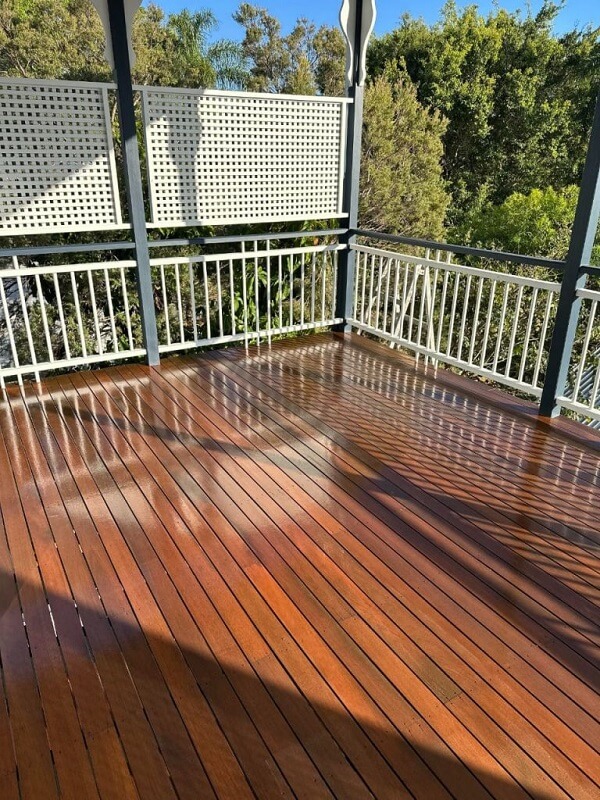
- Merbau. Used for decking and screens across Melbourne. Notorious — it also bleeds a red-brown stain onto adjacent concrete and render.
- Redgum, blackbutt, jarrah and most Australian hardwoods, including hardwood weatherboards on older homes.
- Radiata pine, specifically at the knots. The clear timber is usually fine; the knots are not.
- Oregon and Douglas fir, common in older roof structures and exposed beams.
Why knots are a separate problem
Knots bleed for two reasons, not one. There is tannin, and there is resin.
Resin is not water-soluble, so a water-based stain blocker does nothing to it. Worse, resin softens with heat — a knot on a north-facing door in a Melbourne summer can weep sticky resin straight through two coats of enamel, leaving a raised yellow blister over each knot.
This is why shellac-based primers exist and why painters still use them despite the smell and the methylated spirits cleanup. Shellac blocks both tannin and resin, and it stops heat-driven resin movement in a way nothing water-based manages.
What does not work
- More topcoats. Each one adds water and feeds the problem.
- Water-based stain-blocking primers on tannin. Some are marketed for it. On cedar and hardwood they are unreliable at best.
- Bleach or oxalic acid alone. These lighten the existing stain but do not stop more coming through.
- Sanding back to bare timber and repainting with the same system. The tannin is throughout the timber, not just on the surface.
- Waiting. Tannin bleed does not stabilise or stop on its own while the timber is still getting wet.
What actually fixes it
The sequence matters more than the products.
First, find out whether the timber is getting wet from somewhere. If one patch of a wall is bleeding and the rest is not, suspect a leak, a failed flashing, a blocked gutter or an unsealed joint. Blocking the stain on timber that is still wetting up just moves the failure a few months down the track.
Second, let it dry. Blocking primers go onto dry timber, not damp timber.
Third, clean and sand the surface, then treat the existing stain if it is heavy — oxalic acid will lift most tannin discolouration out of bare timber.
Fourth, prime with an oil-based or shellac-based stain-blocking primer. Shellac for knots and heavy bleed; oil-based is adequate for general tannin on hardwood and is easier to work with over larger areas.
Fifth, and this is the step most often skipped: prime the end grain and every cut edge. End grain absorbs many times more moisture than face grain, and it is where bleeding restarts. Any timber cut on site — a shortened weatherboard, a trimmed architrave, a new deck board — needs its fresh edges primed before it goes up.
Then your two finish coats go on as normal.
Spot priming versus the whole surface
On pine with scattered knots, spot priming the knots with shellac is standard and perfectly sound. On cedar, merbau or hardwood, the whole surface needs priming, because the tannin is not localised.
Getting this wrong in the other direction is expensive. Shellac-priming an entire large exterior when only the knots needed it wastes a lot of money and a lot of time.
Decks and the concrete problem
Merbau decks do something slightly different. When they are first washed or rained on, tannin runs out of the boards and stains whatever is below — pale concrete, pavers, rendered walls. It looks alarming and permanent.
It is usually removable with oxalic acid while fresh, and it slows down considerably after the first year as the surface tannins leach out. New merbau should ideally be washed down and allowed to run before anything underneath it is finished or sealed. If you are planning deck work near new render or light-coloured paving, the order of operations matters.
When to stop and get it looked at
If stains are coming back through a second time, something structural is going on. Either the timber is still taking on moisture, or the wrong primer was used, or the end grain was never sealed. Repainting a third time with the same system will produce the same result.
It is also worth distinguishing tannin bleed from the other things that look similar — rust bleed from fixings, water staining from a leak above, and mould. They need different treatments, and the pattern of the staining usually tells you which one you have.
Get it diagnosed before it is repainted
We look at where the moisture is coming from first, then specify the primer. If you have had stains come back through paint on timber, call 0404 330 332 and we will tell you what is actually causing it.
📍 Our Service Areas Across Melbourne, the Mornington Peninsula, Surf Coast & Phillip Island
Melbourne & Bayside
- Expert Painting and Renovation in Richmond
- Expert Painting and Renovation in St Kilda
- Expert Painting and Renovation in South Yarra
- Expert Painting and Renovation in Malvern
- Expert Painting and Renovation in Hawthorn
- Expert Painting and Renovation in Kew
- Expert Painting and Renovation in Balwyn
- Expert Painting and Renovation in Mount Waverley
- Expert Painting and Renovation in Ringwood
- Expert Painting and Renovation in Doncaster
- Expert Painting and Renovation in Hampton
- Expert Painting and Renovation in Frankston
- Expert Painting and Renovation in Mount Eliza
- Expert Painting and Renovation in Mornington
- Expert Painting and Renovation in Mount Martha
- Expert Painting and Renovation in Rosebud
- Expert Painting and Renovation in Sorrento
Phillip Island & Bass Coast
- Expert Painting and Renovation in Flinders
- Expert Painting and Renovation in Somers
- Expert Painting and Renovation in San Remo
- Expert Painting and Renovation in Cape Woolamai
- Expert Painting and Renovation in Cowes
- Expert Painting and Renovation in Coronet Bay
- Expert Painting and Renovation in Tootgarook
- Expert Painting and Renovation in Rye
- Expert Painting and Renovation in Blairgowrie
- Expert Painting and Renovation in Portsea
- Expert Painting and Renovation in Inverloch
- Expert Painting and Renovation in Kilcunda
- Expert Painting and Renovation in Ventnor
- Expert Painting and Renovation in Newhaven
Surf Coast & Bellarine Peninsula
- Expert Painting and Renovation in Geelong
- Expert Painting and Renovation in Torquay
- Expert Painting and Renovation in Ocean Grove
- Expert Painting and Renovation in Barwon Heads
- Expert Painting and Renovation in Anglesea
- Expert Painting and Renovation in Lorne
- Expert Painting and Renovation in Apollo Bay