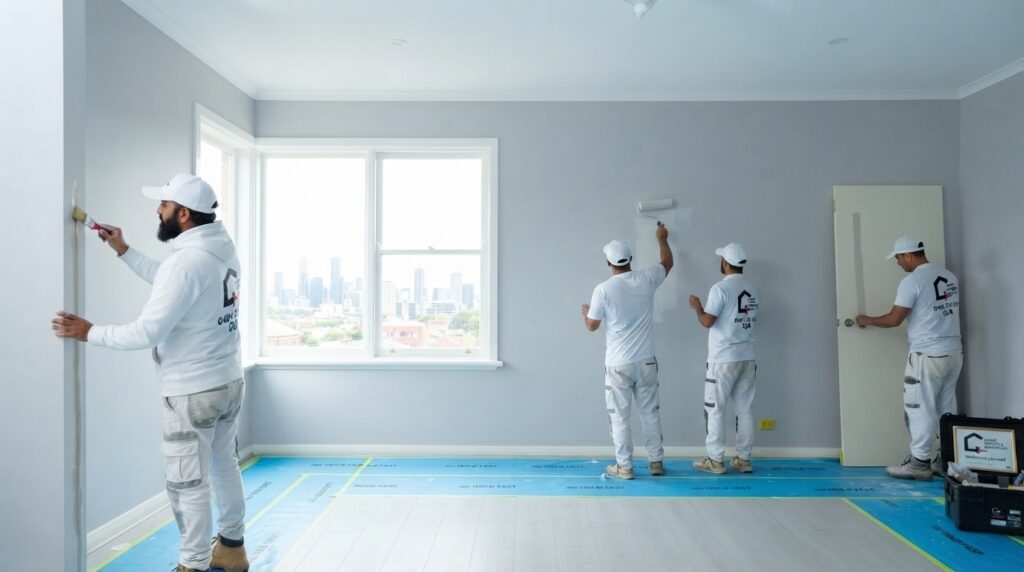

The room is painted, it looks finished, and you want to know whether anyone can sleep in it tonight. The honest answer depends on three things: what went on the walls, how well the room can be aired, and who is sleeping in it.
Touch dry is not the same as safe, and that is where most of the confusion comes from.
Drying and curing are different things
A modern water-based wall paint is touch dry in an hour or two and can be recoated the same day. That is the solvent flashing off the surface. Underneath, the film keeps hardening and releasing a small amount of vapour for days or weeks as it cures properly.
The strong smell belongs to the first stage. The long tail is low-level and most people never notice it. Our guide to how long paint takes to dry covers the recoat side; this is about when the room is comfortable to use again.
Rough timings for a normal, healthy adult
With windows open and reasonable airflow:
- Water-based low-VOC walls and ceilings: usually fine to sleep in after 24 hours, and comfortable after 48
- Water-based enamel on trim and doors: similar, sometimes a day longer because it is a heavier film
- Oil-based or solvent enamel: three days minimum, often a week before the smell genuinely goes
- Whole-house repaint, multiple rooms at once: longer again, simply because there is more wet surface in the building
If you cannot open windows, double every one of those.
The Melbourne winter problem
All of the above assumes ventilation, and for a good part of the year you cannot really provide it. A closed-up house in July with the heating on is the worst case: the paint cures slowly, the vapour has nowhere to go, and the smell lingers for a week in a room that would have cleared in two days in October.
If the work has to happen in winter, plan for it. Run an extraction fan in a window for a few hours a day even when it is cold, keep internal doors open, and do not shut the room up overnight and expect it to be better in the morning. Shoulder seasons are genuinely easier for interior work for this reason.
Who needs longer
This is where general guidance stops being enough, and where it is worth being cautious rather than clever.
- Nurseries and babies. Plan to finish well ahead, not the week before. Give it several days of airing with the door open and the window cracked, and use a low-VOC product throughout. See our nursery room notes
- Pregnancy. The usual advice is to avoid being in the space while painting and immediately afterwards, and to have someone else do the work. Anyone with specific concerns should ask their doctor or midwife rather than take a painter’s word for it
- Asthma and respiratory conditions. Paint vapour is a common trigger. Longer airing, low-VOC products and staying out of the room while it cures
- Birds. This one catches people out. Birds have extremely sensitive respiratory systems and react to fumes at levels humans do not notice. Move them right out of the house, not just to another room, and keep them out until the smell has fully gone
- Cats and dogs. Less sensitive than birds but still worth keeping out of a freshly painted room, mostly because they will walk through it
What low-VOC actually means
It does not mean zero. It means the product falls under a threshold, and the thresholds vary between brands and certification schemes.
Two things worth knowing. Tinting adds VOCs back, so a deep colour in a low-VOC base is not as low as the base on the tin. And low-VOC refers to what the paint emits, not to how it smells: some low-VOC products still have a noticeable odour, and some stronger-smelling products are not especially high in VOCs. Our guide to low-VOC paint goes through the labelling.
How to clear a room faster
What actually works:
- Cross-ventilation, meaning two openings rather than one, so air moves through instead of sitting
- A fan in a window facing outwards, pulling air out of the room
- Gentle warmth, which speeds curing, but not a sealed room with a heater running
- Taking drop sheets, masking tape, rags and empty tins out of the house, not leaving them in the hallway
- Opening wardrobe and cupboard doors if their interiors were painted, because those hold vapour longest
What does not work: bowls of vinegar, cut onions, coffee grounds or charcoal. They mask or absorb a little odour. They do not speed curing and they do not remove what is causing the smell.
When a smell should concern you
Most lingering smells are just slow curing in a cold, closed room. A few are telling you something:
- A smell that is getting stronger rather than weaker after several days
- A sour or musty note rather than a paint note, which can mean the wall was damp when it was coated
- Paint that is still soft or tacky after two or three days, which usually means it went on too thick, over an incompatible surface, or in conditions that were too cold or too humid
- Headaches or eye irritation that persist in that room specifically
Any of those is worth a call. Painting over a damp wall is the most common cause and it does not resolve itself.
What we do
- Low-VOC and water-based systems as standard for interiors
- Honest timing advice before we start, including whether a date is realistic for a nursery or a bedroom
- Ventilation planned into the job rather than left to you afterwards
- Staged room-by-room work so you always have somewhere to sleep
- Clean-up and removal of materials from the house at the end of each day
We are based in Richmond and work across Melbourne, the bayside suburbs and coastal Victoria.
Call 0404 330 332. If there is a baby due or someone in the house with asthma, tell us at the quote stage and we will plan the products and the timing around it.
This is general guidance about paint and ventilation, not medical advice. For health questions specific to you, speak to your doctor.
📍 Our Service Areas Across Melbourne, the Mornington Peninsula, Surf Coast & Phillip Island
Melbourne & Bayside
- Expert Painting and Renovation in Richmond
- Expert Painting and Renovation in St Kilda
- Expert Painting and Renovation in South Yarra
- Expert Painting and Renovation in Malvern
- Expert Painting and Renovation in Hawthorn
- Expert Painting and Renovation in Kew
- Expert Painting and Renovation in Balwyn
- Expert Painting and Renovation in Mount Waverley
- Expert Painting and Renovation in Ringwood
- Expert Painting and Renovation in Doncaster
- Expert Painting and Renovation in Hampton
- Expert Painting and Renovation in Frankston
- Expert Painting and Renovation in Mount Eliza
- Expert Painting and Renovation in Mornington
- Expert Painting and Renovation in Mount Martha
- Expert Painting and Renovation in Rosebud
- Expert Painting and Renovation in Sorrento
Phillip Island & Bass Coast
- Expert Painting and Renovation in Flinders
- Expert Painting and Renovation in Somers
- Expert Painting and Renovation in San Remo
- Expert Painting and Renovation in Cape Woolamai
- Expert Painting and Renovation in Cowes
- Expert Painting and Renovation in Coronet Bay
- Expert Painting and Renovation in Tootgarook
- Expert Painting and Renovation in Rye
- Expert Painting and Renovation in Blairgowrie
- Expert Painting and Renovation in Portsea
- Expert Painting and Renovation in Inverloch
- Expert Painting and Renovation in Kilcunda
- Expert Painting and Renovation in Ventnor
- Expert Painting and Renovation in Newhaven
Surf Coast & Bellarine Peninsula
- Expert Painting and Renovation in Geelong
- Expert Painting and Renovation in Torquay
- Expert Painting and Renovation in Ocean Grove
- Expert Painting and Renovation in Barwon Heads
- Expert Painting and Renovation in Anglesea
- Expert Painting and Renovation in Lorne
- Expert Painting and Renovation in Apollo Bay