
Painting fibre cement is more forgiving than painting timber, and the coating lasts longer. The board does not swell, shrink or bleed, so most of what goes wrong on weatherboards simply does not happen.
What does go wrong is almost always at the edges, the joints and the fixings. Here is what matters.
First: how old is it?
This has to come before anything else.
Fibre cement sheeting manufactured in Australia before the late 1980s may contain asbestos. The common name is fibro, and it looks very similar to modern board from a distance. Modern Australian fibre cement — cement, sand and cellulose fibre — contains no asbestos.
If your cladding predates about 1987 and has not been identified, do not sand it, cut it, drill it or high-pressure wash it. Get it tested first. Painting asbestos cement that is in sound condition is generally acceptable and is often the recommended way to stabilise it, but the preparation has to be done without creating dust, and that is licensed work.
Nothing below applies until that question is settled.
Why painting fibre cement outlasts timber
Three reasons, and they are worth knowing because they change the maintenance cycle.
It is dimensionally stable. Fibre cement barely moves with changes in moisture or temperature, so the paint film is not constantly being stretched and compressed the way it is on timber weatherboards.
It has no tannins and no resin. There is nothing in the board to bleed through your topcoat, so no shellac primer, no knot blocking, none of the staining problems that come with hardwood and cedar.
It does not rot. Water that gets behind timber starts decay; on fibre cement it is a nuisance rather than a structural problem.
In practice a well-painted fibre cement exterior holds its coating noticeably longer than the same job on timber.
The cut edges are where it fails
If you remember one thing about painting fibre cement, make it this.
Boards leave the factory with sealed edges. Every cut made on site — at a corner, around a window, at the end of a run — exposes raw board. Raw fibre cement wicks water readily, and water entering a cut edge is the most common cause of paint failure, swelling and board damage on an otherwise sound wall.
Every site-cut edge needs sealing before the board goes up, and any exposed edge found during a repaint needs priming before the topcoat. On an older house this means checking the ends of every run and both sides of every external corner.
The other failure points
- Joints. Vertical joints between sheets rely on flashing or a sealant bead. Perished sealant lets water into the wall and behind the board.
- Expansion gaps. The small gaps at window and door frames are deliberate. Filling them solid with a rigid filler causes cracking as the structure moves.
- Nail and screw heads. Fixings should be set just below the surface and filled. Proud fixings telegraph through paint; rusting ones stain it.
- Ground clearance. Board that sits too close to soil, paving or garden beds stays damp and will show paint failure along the bottom regardless of what you put on it.
Preparation before painting fibre cement
Wash it, but gently. High-pressure water on fibre cement drives moisture into joints and behind sheets, and the wall needs days to dry afterwards. Low pressure and a stiff brush is better.
Check and replace perished sealant at joints and frames before any paint goes on. Fill fixings and sand them flush. Scrape back any flaking areas to sound material — but if there is any doubt about the age of the board, see the first section.
Then let it dry properly. Fibre cement holds water longer than it looks.
New board is alkaline
Freshly installed fibre cement and any new patching compound are alkaline, and alkalinity attacks ordinary paint from underneath. That shows up as patchy gloss, colour change or peeling, usually within months.
New board needs either a product rated for it or an alkali-resistant sealer first. Factory-primed boards are a head start, not a finished surface — the primer has a stated window, often around three to six months, after which it should be top-coated or re-primed. Boards that have sat exposed through a Melbourne summer past that window usually need re-priming.
Use acrylic systems. Oil-based products do not suit fibre cement well, particularly over fresh board.
If you are considering recladding
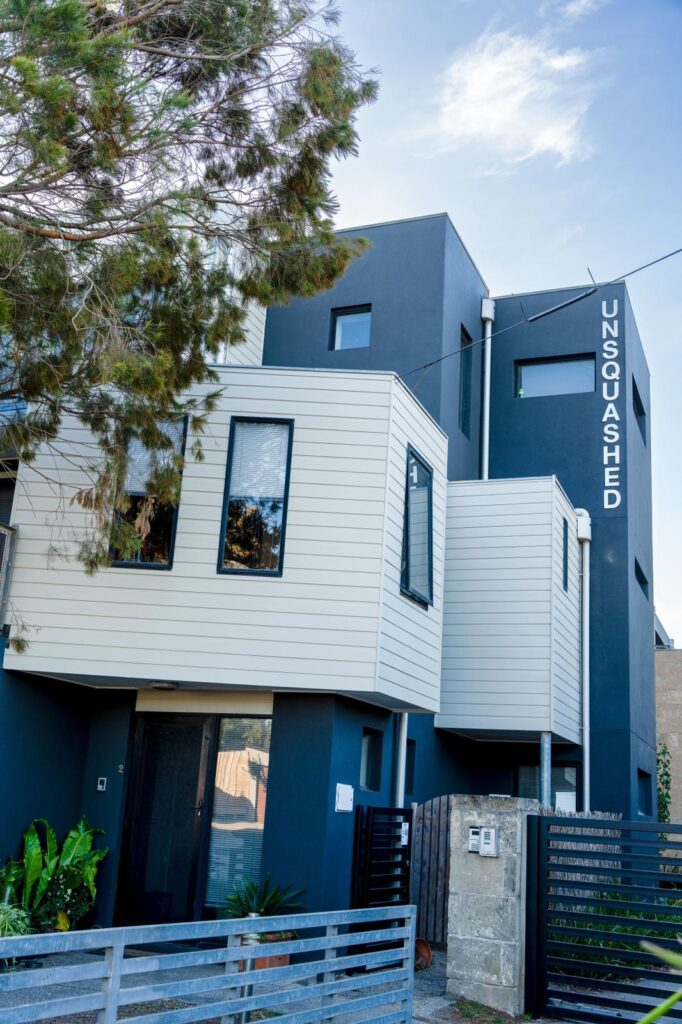
Fibre cement is the usual replacement when weatherboards have gone past repair, and it comes in profiles that read very like timber from the street. Pre-finished versions need no painting initially, though they are maintenance-deferred rather than maintenance-free.
If you are weighing that decision, the trade-offs are worth understanding before anyone quotes.
Get the boards checked first
We identify the board, check every cut edge and joint, and tell you what the wall actually needs. If your cladding is old enough to be uncertain, we will say so before anyone touches it. Call 0404 330 332.
📍 Our Service Areas Across Melbourne, the Mornington Peninsula, Surf Coast & Phillip Island
Melbourne & Bayside
- Expert Painting and Renovation in Richmond
- Expert Painting and Renovation in St Kilda
- Expert Painting and Renovation in South Yarra
- Expert Painting and Renovation in Malvern
- Expert Painting and Renovation in Hawthorn
- Expert Painting and Renovation in Kew
- Expert Painting and Renovation in Balwyn
- Expert Painting and Renovation in Mount Waverley
- Expert Painting and Renovation in Ringwood
- Expert Painting and Renovation in Doncaster
- Expert Painting and Renovation in Hampton
- Expert Painting and Renovation in Frankston
- Expert Painting and Renovation in Mount Eliza
- Expert Painting and Renovation in Mornington
- Expert Painting and Renovation in Mount Martha
- Expert Painting and Renovation in Rosebud
- Expert Painting and Renovation in Sorrento
Phillip Island & Bass Coast
- Expert Painting and Renovation in Flinders
- Expert Painting and Renovation in Somers
- Expert Painting and Renovation in San Remo
- Expert Painting and Renovation in Cape Woolamai
- Expert Painting and Renovation in Cowes
- Expert Painting and Renovation in Coronet Bay
- Expert Painting and Renovation in Tootgarook
- Expert Painting and Renovation in Rye
- Expert Painting and Renovation in Blairgowrie
- Expert Painting and Renovation in Portsea
- Expert Painting and Renovation in Inverloch
- Expert Painting and Renovation in Kilcunda
- Expert Painting and Renovation in Ventnor
- Expert Painting and Renovation in Newhaven
Surf Coast & Bellarine Peninsula
- Expert Painting and Renovation in Geelong
- Expert Painting and Renovation in Torquay
- Expert Painting and Renovation in Ocean Grove
- Expert Painting and Renovation in Barwon Heads
- Expert Painting and Renovation in Anglesea
- Expert Painting and Renovation in Lorne
- Expert Painting and Renovation in Apollo Bay