
White is the hardest colour to choose and the one people spend the least time on. There are hundreds of them, they look identical on the chart, and they look nothing like the chart once they are on the wall.
Here is what actually decides whether a white works in a Melbourne house.
Every white has an undertone
There is no such thing as a neutral white in practice. Each one is tinted, and the tint is what you end up living with:
- Warm whites lean yellow, cream or red. They read as soft and comfortable, and can look dirty or dated next to cool materials
- Cool whites lean blue, grey or green. They read as crisp and contemporary, and can look stark and cold in the wrong room
- Stark or pure whites have almost no tint. They are brilliant in strong light and unforgiving everywhere else
You cannot see the undertone on a small chip. You see it the moment two square metres of it go on a wall, and by then the room is painted.
Which way the room faces decides more than the colour does
This is the part most online advice gets backwards, because most of it is written for the northern hemisphere. In Melbourne it is the other way around.
- North-facing rooms get warm, direct sun for most of the day. They can carry a cooler white comfortably, and a warm white in there can tip yellow
- South-facing rooms get cool, indirect light all day and never take direct sun. A cool or stark white will look grey and cold. These rooms want a warm or soft white
- East-facing rooms are warm in the morning and flat by afternoon
- West-facing rooms take hard, orange late-afternoon light that exaggerates any warmth already in the paint
Melbourne adds its own problem: long stretches of grey overcast. A white chosen on a bright February afternoon can look completely different through July, and the south-facing rooms are where that shows up worst.
LRV, and why the same white looks different in two rooms
Light Reflectance Value is a number from 0 to 100 telling you how much light a colour bounces back. Most whites sit between 80 and 92.
It matters because a high-LRV white in a bright north-facing room can be genuinely glary, while the same paint in a dim south-facing hallway simply looks grey. If a room has one small window, a higher LRV is working for you. If it has full northern glazing, slightly lower is usually more comfortable to live with.
The fixed things in the room get a vote
Paint is the cheapest element in any room, so it should be chosen last, around everything that is already there.
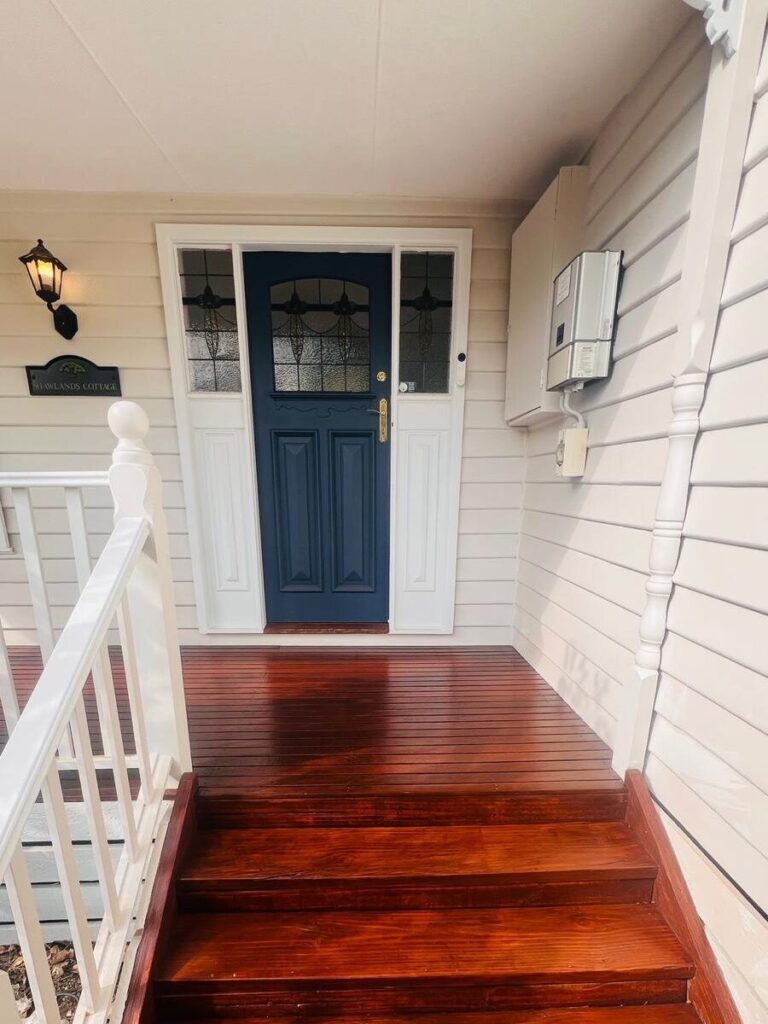
Warm timber floors such as Tassie oak, blackbutt or spotted gum push a cool white to look blue by contrast. Grey engineered flooring, concrete, black tapware and white stone do the opposite and make a warm white look yellow and tired.
Hold your options directly against the floor, the benchtop, the tiles and the window frames before deciding. The fight is always between the paint and the fixed finishes, not between two paint colours.
How to test properly
Sample pots are worth the hour they take.
- Paint at least an A4-sized patch, preferably bigger. A brush-out on a card is not enough
- Use two coats, because one coat shows the surface underneath
- Put the same white on two different walls in the room, including the darkest one
- Leave it for a full day and look at it in morning light, afternoon light and under your own lights at night
- Do not paint the samples next to each other on the same wall, because each one shifts how the others look. Leave a gap
Artificial light matters as much as daylight. Warm LEDs at 2700K will pull any white warmer at night; cool 4000K lighting will make a warm white look washed out.
Walls, trim and ceilings are three different decisions
Using one white everywhere is the most common shortcut and it flattens a room.
The usual approach is a white or near-white on the walls, a crisper white on the trim in a higher sheen, and a dedicated ceiling white. Some people use the wall colour at half or quarter strength on the ceiling, which keeps the room consistent and stops the ceiling looking disconnected.
Sheen does a lot of the work here. The same colour in a low-sheen on the wall and a semi-gloss on the architraves reads as two deliberate tones. Our guide to paint sheens covers which goes where.
For period homes the rules shift again, since the mouldings and the era carry their own conventions. See our notes on heritage colour schemes.
Popular is not the same as right
A handful of whites dominate Melbourne interiors because they are genuinely versatile, and one of them may well be right for your house. But a colour that photographs beautifully in a north-facing display home can look grey and flat in a south-facing Victorian terrace with one window.
We have written separately about one of the most-requested of them, Dulux Lexicon in Melbourne homes. The point of that piece is the same as this one: it depends on the room.
If the house has several small rooms, our notes on paint colours for small rooms are worth reading alongside this.
When to get help
If the house is open plan, with rooms facing different directions flowing into each other, a scheme is harder than a single colour choice. One white has to work in northern sun and southern shade at the same time, and that is a genuine design problem rather than a shopping decision. A colour consultation costs less than repainting a mistake.
What we do
- Walk the house and note which way each room faces before any colour talk
- Supply and apply sample patches so you are judging the real thing
- Advise on wall, trim and ceiling combinations rather than a single colour
- Match sheen to the room and the surface
- Record every product, colour code and sheen at handover so touch-ups actually match later
We are based in Richmond and work across Melbourne and coastal Victoria.
Call 0404 330 332. If you are stuck between two whites, that is a normal place to be stuck and we can usually settle it on site in ten minutes.
📍 Our Service Areas Across Melbourne, the Mornington Peninsula, Surf Coast & Phillip Island
Melbourne & Bayside
- Expert Painting and Renovation in Richmond
- Expert Painting and Renovation in St Kilda
- Expert Painting and Renovation in South Yarra
- Expert Painting and Renovation in Malvern
- Expert Painting and Renovation in Hawthorn
- Expert Painting and Renovation in Kew
- Expert Painting and Renovation in Balwyn
- Expert Painting and Renovation in Mount Waverley
- Expert Painting and Renovation in Ringwood
- Expert Painting and Renovation in Doncaster
- Expert Painting and Renovation in Hampton
- Expert Painting and Renovation in Frankston
- Expert Painting and Renovation in Mount Eliza
- Expert Painting and Renovation in Mornington
- Expert Painting and Renovation in Mount Martha
- Expert Painting and Renovation in Rosebud
- Expert Painting and Renovation in Sorrento
Phillip Island & Bass Coast
- Expert Painting and Renovation in Flinders
- Expert Painting and Renovation in Somers
- Expert Painting and Renovation in San Remo
- Expert Painting and Renovation in Cape Woolamai
- Expert Painting and Renovation in Cowes
- Expert Painting and Renovation in Coronet Bay
- Expert Painting and Renovation in Tootgarook
- Expert Painting and Renovation in Rye
- Expert Painting and Renovation in Blairgowrie
- Expert Painting and Renovation in Portsea
- Expert Painting and Renovation in Inverloch
- Expert Painting and Renovation in Kilcunda
- Expert Painting and Renovation in Ventnor
- Expert Painting and Renovation in Newhaven
Surf Coast & Bellarine Peninsula
- Expert Painting and Renovation in Geelong
- Expert Painting and Renovation in Torquay
- Expert Painting and Renovation in Ocean Grove
- Expert Painting and Renovation in Barwon Heads
- Expert Painting and Renovation in Anglesea
- Expert Painting and Renovation in Lorne
- Expert Painting and Renovation in Apollo Bay