
Whole house or room by room is usually a budget question. The house needs painting, the number for all of it is more than you wanted to spend, and splitting it across two or three years looks like the sensible compromise.
Sometimes it is. Often it costs more in total than doing it at once, and there are a few places where splitting the job leaves a visible join you cannot undo. Worth understanding before you decide.
Whole house or room by room: why all at once is cheaper
A painting job has fixed costs that do not shrink when the job gets smaller.
- Setting up and packing down, every single visit
- Masking and floor protection, relaid each time
- Access equipment hired and erected again
- Travel and minimum charges for short visits
- Paint bought in small quantities, which costs more per litre than buying 10 or 15 litre tins
Split a house into three visits and you pay those three times. The painting itself barely changes, but the overheads roughly triple.
In practice, doing a whole interior at once usually lands well below the sum of the same rooms quoted separately, and the gap widens the more you split it.
The surfaces that do not have a clean stopping point
This is the part that catches people out. Some surfaces simply do not have an edge to stop at.
- A ceiling that runs continuously from the living room through to the kitchen in an open-plan space. There is no line. Stopping mid-ceiling leaves a join that shows in raking light forever.
- Hallways, which touch every room and have to be done with something.
- Cornices and skirting runs that continue around a corner without a break.
- A stairwell void connecting two levels.
Where a room has a door frame all the way around it, it can be isolated cleanly. Where it opens into another space, it usually cannot. Walk the house and look for the actual break lines before assuming the rooms are separable.
The colour-matching problem
If you paint the back half of the house this year and the front half in two years, you have two batches of the same colour applied two years apart.
Paint is tinted in batches and small differences exist between them. On top of that, the first half has had two years of light on it. Where those two areas meet — and they will meet somewhere — there can be a visible difference in a colour that is nominally identical.
It is worse with strong or dark colours and with anything above a low sheen. On an off-white in a matt finish, most people never notice. It is also a reason to record the brand, colour code, sheen and batch from the first visit.
When room by room is genuinely the right call
There are good reasons to split a job, and cash flow is a legitimate one.
- The budget simply is not there, and waiting two years to do anything means two more years of deterioration
- A baby is due, or someone is unwell, and the house cannot be disrupted all at once
- You are renovating in stages and some rooms will be pulled apart later anyway
- A rental between tenancies, where you get a short window
- One room has a specific problem — mould, water damage, a failed previous job — that needs dealing with now
- You are testing a colour scheme before committing to the whole house
In those situations splitting is sensible. The point is to split deliberately rather than by accident.
The hybrid that usually works best
If the whole house is out of reach, the most economical split is almost never room by room.
Do all the ceilings and all the connecting spaces — hallway, stairs, open-plan areas — in one go, along with any trim that runs continuously. Those are the surfaces that cannot be broken cleanly, and getting them done together removes the join problem permanently.
Then the individual bedrooms, which are genuinely isolated behind door frames, can be picked off later in any order without anyone ever seeing a line.
That approach costs more than a single room now and far less than three separate visits later, and it protects the parts of the finish you cannot fix retrospectively.
Exteriors split differently
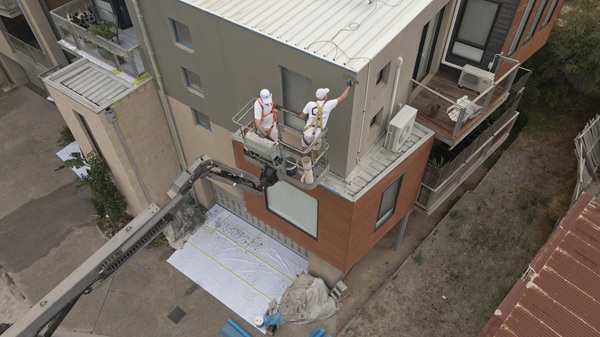
Outside, the natural division is by elevation rather than by room, and it works much better. Each wall has a corner at each end, which is a genuine stopping point.
Doing the exposed elevations first and the sheltered ones later is a legitimate maintenance strategy rather than a compromise, because those walls are on genuinely different cycles anyway.
Keep the records either way
Whichever way you go, write down for every surface: brand, product line, colour name and code, sheen, and the date. Put it somewhere you will find it in three years.
If you are splitting the work, that record is what makes the second visit match the first. Without it, matching becomes guesswork and the join becomes visible.
Get both numbers before you decide
Ask for the job quoted both ways — whole house, and staged — so you can see the real difference rather than assuming it. We will price it either way and tell you which surfaces genuinely cannot be split. Call 0404 330 332.
📍 Our Service Areas Across Melbourne, the Mornington Peninsula, Surf Coast & Phillip Island
Melbourne & Bayside
- Expert Painting and Renovation in Richmond
- Expert Painting and Renovation in St Kilda
- Expert Painting and Renovation in South Yarra
- Expert Painting and Renovation in Malvern
- Expert Painting and Renovation in Hawthorn
- Expert Painting and Renovation in Kew
- Expert Painting and Renovation in Balwyn
- Expert Painting and Renovation in Mount Waverley
- Expert Painting and Renovation in Ringwood
- Expert Painting and Renovation in Doncaster
- Expert Painting and Renovation in Hampton
- Expert Painting and Renovation in Frankston
- Expert Painting and Renovation in Mount Eliza
- Expert Painting and Renovation in Mornington
- Expert Painting and Renovation in Mount Martha
- Expert Painting and Renovation in Rosebud
- Expert Painting and Renovation in Sorrento
Phillip Island & Bass Coast
- Expert Painting and Renovation in Flinders
- Expert Painting and Renovation in Somers
- Expert Painting and Renovation in San Remo
- Expert Painting and Renovation in Cape Woolamai
- Expert Painting and Renovation in Cowes
- Expert Painting and Renovation in Coronet Bay
- Expert Painting and Renovation in Tootgarook
- Expert Painting and Renovation in Rye
- Expert Painting and Renovation in Blairgowrie
- Expert Painting and Renovation in Portsea
- Expert Painting and Renovation in Inverloch
- Expert Painting and Renovation in Kilcunda
- Expert Painting and Renovation in Ventnor
- Expert Painting and Renovation in Newhaven
Surf Coast & Bellarine Peninsula
- Expert Painting and Renovation in Geelong
- Expert Painting and Renovation in Torquay
- Expert Painting and Renovation in Ocean Grove
- Expert Painting and Renovation in Barwon Heads
- Expert Painting and Renovation in Anglesea
- Expert Painting and Renovation in Lorne
- Expert Painting and Renovation in Apollo Bay