
Heritage colour schemes in Melbourne follow a logic that most modern palettes ignore. The city has one of the largest stocks of intact Victorian, Edwardian and interwar housing anywhere, and the quickest way to make one of those houses look wrong is a colour scheme borrowed from a new build.
This guide covers what suited each era, how a traditional scheme is structured, and the decisions that are hard to undo.
How heritage colour schemes in Melbourne are built
Period exteriors almost always used three colours, each with a job:
Body. The largest area: weatherboards, or rendered walls. Usually the lightest and most neutral of the three.
Trim. Window frames, fascias, barge boards, verandah posts and beams. A stronger colour that defines the shape of the house.
Highlight. Front door, window sashes, ironwork and decorative detail. The darkest or richest colour, used sparingly.
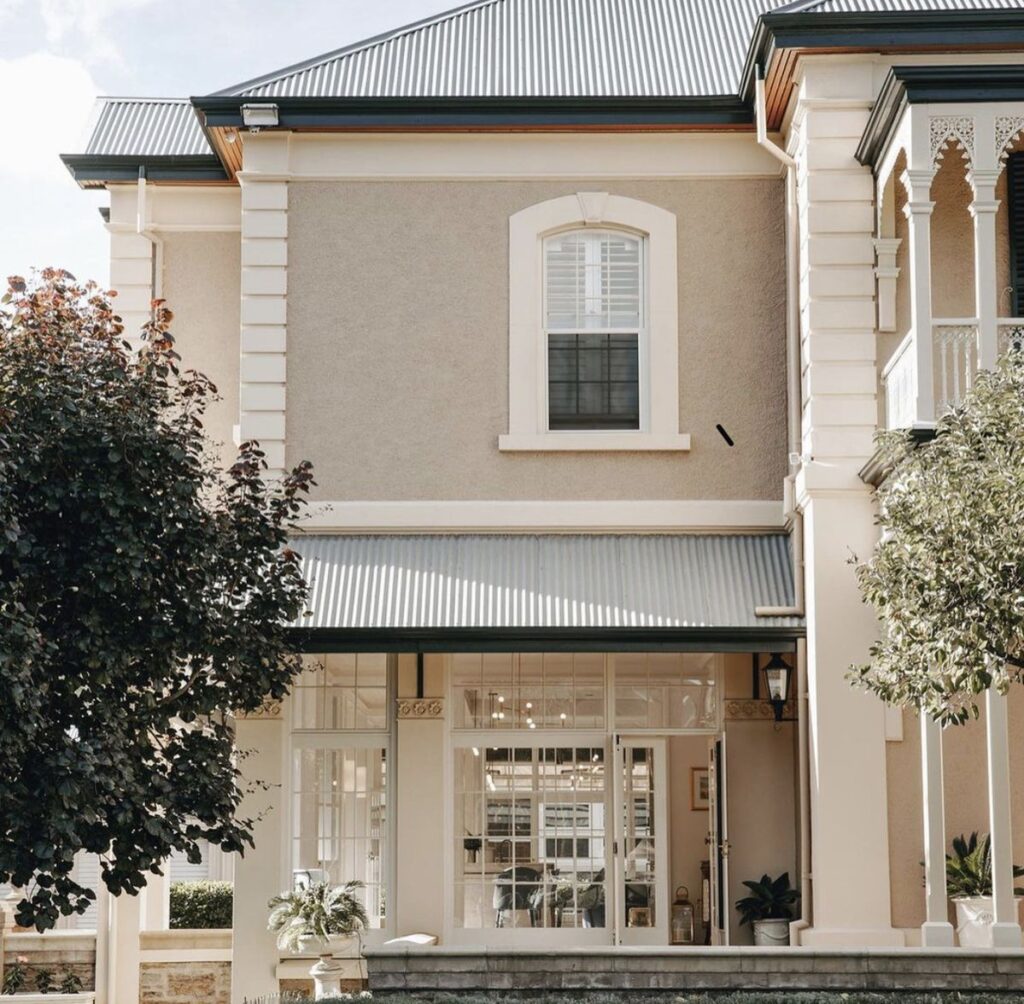
Modern two-colour schemes flatten a period facade because the detail the house was designed to show off disappears. The three-part structure is what makes the lacework, the fretwork and the window joinery read properly from the street.
What suited each era
| Era | Typical body | Trim | Highlight |
|---|---|---|---|
| Victorian, 1850s–1901 | Stone, cream, soft ochre | Indian red, bronze green, deep brown | Dark green, deep red, black ironwork |
| Edwardian / Federation, 1901–1918 | Cream, off-white, soft grey | Red oxide, Brunswick green | Stained timber, deep red doors |
| Californian bungalow, 1920s–1930s | Cream, warm stone | Earthy brown, olive, muted green | Dark stained timber |
| Art Deco, 1930s | Cream, white, soft pastel render | Minimal, often tonal | Deep accents on doors and steel |
Two patterns are worth noticing. Victorian schemes were richer and darker than most people expect; the pale grey-and-white palette often applied to terraces today is a modern invention. And Federation homes made far more use of natural stained timber on shingles, fretwork and verandah detail than of paint.
The decisions that are hard to undo
Do not paint original face brick. This is the big one. Melbourne's Victorian polychrome brickwork and Federation red brick were never meant to be painted. Once painted, brick cannot realistically be returned to its original state, the paint traps moisture in a wall designed to breathe, and the surface then needs repainting forever. It frequently reduces the value of a period property rather than adding to it.
If the brick is in poor condition, cleaning and repointing is the right path. If you want a rendered look, understand that you are making a permanent change.
Check the heritage overlay. Many inner Melbourne suburbs have heritage controls, and in some cases exterior colour and finish changes to a street-facing elevation need council approval. Heritage Victoria publishes the state heritage register and general guidance on works to heritage places, and your local council administers the overlay itself. Painting previously unpainted masonry is the change most likely to require a permit. Check with your council before work starts, not after.
Find out what was there. A careful scrape-back in a protected spot, such as under a verandah beam or behind a downpipe, will often reveal the original layers. It takes ten minutes and it frequently settles an argument.
Practical notes for Melbourne conditions
- Deep colours fade faster, particularly reds and some greens, and particularly on north and west-facing elevations. Budget for a shorter recoat interval on those walls.
- Cast and wrought iron traditionally reads dark. It also needs proper rust preparation before any colour goes on — see painting metal railings and gates.
- Pre-1970 homes almost certainly carry lead paint under later coats, which changes how preparation must be done. Dry sanding a Victorian weatherboard is unsafe. See lead paint in Melbourne homes.
- Coordinate with the roof. Terracotta tiles sit comfortably with warm, earthy schemes and fight cool greys. If the roof is staying, it is a fixed point in the palette.
- Test on the house. Paint boards and move them around the facade at different times of day. Period colours in particular shift considerably between morning and late afternoon light.
Working with neighbours and the street
On a terrace row, your facade is part of a composition. A scheme that is sympathetic to the row usually looks better than one that announces itself, and it tends to serve you better at sale time too. That does not mean copying next door; it means choosing colours of a similar depth and period so the row still reads as a row.
Expert Painting and Renovation
Expert Painting and Renovation is a family-run, Aussie-local company based in Richmond with more than 9 years of experience on Melbourne homes, a great many of them period properties in the inner suburbs.
We work with heritage schemes regularly, we prepare pre-1970 homes using lead-safe methods, and we will tell you when a proposal — painting original brick, for instance — is something you may regret. Our work covers exterior painting, house painting, weatherboard restoration and timber restoration. For period homes specifically, see our guides to heritage home painting and painting a Richmond terrace.
See our portfolio, check coverage on our service areas page, or contact us.
FAQ
Do I need council approval to repaint my period home? If the property is in a heritage overlay, exterior colour changes to a street-facing elevation may require approval, and painting previously unpainted brickwork very often does. Check with your council first.
Should I paint my red brick Victorian terrace? Generally no. It is effectively permanent, it traps moisture in a wall built to breathe, and it commits you to repainting indefinitely. Cleaning and repointing is usually the better path.
How do I find the original colours? A careful scrape-back through the paint layers in a sheltered spot will usually reveal them. Several manufacturers also publish heritage ranges based on documented period palettes.
Are grey and white wrong on a Victorian? Not wrong, but not historically accurate either. Original Victorian schemes were considerably richer and darker. A cool modern palette can look thin on a facade designed for depth.
How many colours should a period scheme use? Three is traditional: body, trim and highlight. It is what makes the detail read from the street.
About Expert Painting & Renovation
Expert Painting and Renovation is an Aussie-local, family-run company based in Richmond, Melbourne, with more than 9 years of experience in residential and commercial painting and renovation. Our specialists deliver premium workmanship, timely service and durable finishes designed for Melbourne homes.
- Ceiling crack repairs
- Sagging ceiling restoration
- Water‑damaged ceiling repairs
- Cornice replacement
- Full plastering services
- Interior & exterior painting
- Weatherboard restoration
- Deck & timber maintenance
- Roof painting
- Rendering & texture coating
- Commercial Painting
- Plastering Services
- House Painting
Whether you need maintenance advice, a single-room refresh or a full home makeover, our team is just a call away.
📍 Our Service Areas Across Melbourne, the Mornington Peninsula, Surf Coast & Phillip Island
Melbourne & Bayside
- Expert Painting and Renovation in Richmond
- Expert Painting and Renovation in St Kilda
- Expert Painting and Renovation in South Yarra
- Expert Painting and Renovation in Malvern
- Expert Painting and Renovation in Hawthorn
- Expert Painting and Renovation in Kew
- Expert Painting and Renovation in Balwyn
- Expert Painting and Renovation in Mount Waverley
- Expert Painting and Renovation in Ringwood
- Expert Painting and Renovation in Doncaster
- Expert Painting and Renovation in Hampton
- Expert Painting and Renovation in Frankston
- Expert Painting and Renovation in Mount Eliza
- Expert Painting and Renovation in Mornington
- Expert Painting and Renovation in Mount Martha
- Expert Painting and Renovation in Rosebud
- Expert Painting and Renovation in Sorrento
Phillip Island & Bass Coast
- Expert Painting and Renovation in Flinders
- Expert Painting and Renovation in Somers
- Expert Painting and Renovation in San Remo
- Expert Painting and Renovation in Cape Woolamai
- Expert Painting and Renovation in Cowes
- Expert Painting and Renovation in Coronet Bay
- Expert Painting and Renovation in Tootgarook
- Expert Painting and Renovation in Rye
- Expert Painting and Renovation in Blairgowrie
- Expert Painting and Renovation in Portsea
- Expert Painting and Renovation in Inverloch
- Expert Painting and Renovation in Kilcunda
- Expert Painting and Renovation in Ventnor
- Expert Painting and Renovation in Newhaven
Surf Coast & Bellarine Peninsula
- Expert Painting and Renovation in Geelong
- Expert Painting and Renovation in Torquay
- Expert Painting and Renovation in Ocean Grove
- Expert Painting and Renovation in Barwon Heads
- Expert Painting and Renovation in Anglesea
- Expert Painting and Renovation in Lorne
- Expert Painting and Renovation in Apollo Bay